Geometric Graph Learning to Predict Changes in Binding Free Energy and Protein Thermodynamic Stability upon Mutation
Abstract
Accurate prediction of binding free energy changes upon mutations is vital for optimizing drugs, designing proteins, understanding genetic diseases, and cost-effective virtual screening. While machine learning methods show promise in this domain, achieving accuracy and generalization across diverse data sets remains a challenge. This study introduces Geometric Graph Learning for Protein–Protein Interactions (GGL-PPI), a novel approach integrating geometric graph representation and machine learning to forecast mutation-induced binding free energy changes. GGL-PPI leverages atom-level graph coloring and multiscale weighted colored geometric subgraphs to capture structural features of biomolecules, demonstrating superior performance on three standard data sets, namely, AB-Bind, SKEMPI 1.0, and SKEMPI 2.0 data sets. The model’s efficacy extends to predicting protein thermodynamic stability in a blind test set, providing unbiased predictions for both direct and reverse mutations and showcasing notable generalization. GGL-PPI’s precision in predicting changes in binding free energy and stability due to mutations enhances our comprehension of protein complexes, offering valuable insights for drug design endeavors.
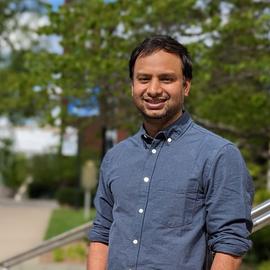
Masud Rana
Assistant Professor of Mathematics, Kennesaw State University (former Nguyen Lab postdoc)
Masud Rana is an assistant professor of mathematics at Kennesaw State University and a former postdoctoral scholar in the Nguyen Lab. He works on graph-theoretic and geometric methods for AI-driven drug discovery.
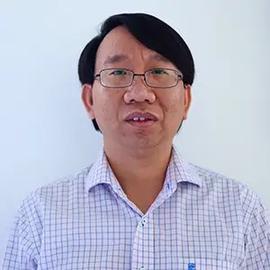
Duc Nguyen
Associate Professor of Mathematics
Duc Nguyen develops mathematical and AI frameworks for molecular bioscience, drug discovery, and scientific computing. His group blends differential geometry, graph theory, and machine learning to build high-fidelity models for biomolecular systems, with notable wins in the D3R Grand Challenges and collaborations with Pfizer and Bristol Myers Squibb. Supported by multiple NSF awards, he has advised students and postdocs across theory and applications of AI-driven drug design.