Abstract
It remains a challenging task to generate a vast variety of novel compounds with desirable pharmacological properties. In this work, a generative network complex (GNC) is proposed as a new platform for designing novel compounds, predicting their physical and chemical properties, and selecting potential drug candidates that fulfill various druggable criteria such as binding affinity, solubility, partition coefficient, etc. We combine a SMILES string generator, which consists of an encoder, a drug-property controlled or regulated latent space, and a decoder, with verification deep neural networks, a target-specific three-dimensional (3D) pose generator, and mathematical deep learning networks to generate new compounds, predict their drug properties, construct 3D poses associated with target proteins, and reevaluate druggability, respectively. New compounds were generated in the latent space by either randomized output, controlled output, or optimized output. In our demonstration, 2.08 million and 2.8 million novel compounds are generated respectively for Cathepsin S and BACE targets. These new compounds are very different from the seeds and cover a larger chemical space. For potentially active compounds, their 3D poses are generated using a state-of-the-art method. The resulting 3D complexes are further evaluated for druggability by a championing deep learning algorithm based on algebraic topology, differential geometry, and algebraic graph theories. Performed on supercomputers, the whole process took less than one week. Therefore, our GNC is an efficient new paradigm for discovering new drug candidates.
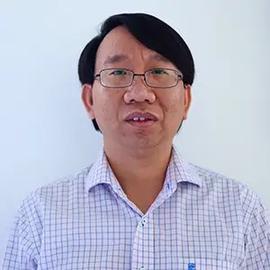
Duc Nguyen
Associate Professor of Mathematics
Duc Nguyen develops mathematical and AI frameworks for molecular bioscience, drug discovery, and scientific computing. His group blends differential geometry, graph theory, and machine learning to build high-fidelity models for biomolecular systems, with notable wins in the D3R Grand Challenges and collaborations with Pfizer and Bristol Myers Squibb. Supported by multiple NSF awards, he has advised students and postdocs across theory and applications of AI-driven drug design.