MMGNN: Multi-level, multi-color graph neural networks for molecular property prediction
Abstract
Molecular message-passing neural networks commonly propagate chemically diverse interactions through a single graph, which may mix interaction-specific signals and require deep propagation to capture long-range effects. We introduce the Multi-level, Multi-color Graph Neural Network (MMGNN), a hierarchical framework that decomposes a molecular graph into overlapping atom-type-pair-specific subgraphs while preserving atom-level resolution. MMGNN-2D constructs chemical-colored subgraphs from covalent connectivity, whereas MMGNN-3D constructs geometric-colored subgraphs from spatial proximity and augments their edges with distance, angular, and torsional descriptors. Both variants apply a shared communicative message-passing backbone to each subgraph and combine the resulting representations through atom-wise aggregation and molecular readout. We evaluated MMGNN on five classification and three regression benchmarks from MoleculeNet using common scaffold splits and five independent runs. MMGNN-2D achieved the highest macro-average AUC-ROC of 0.838 across the classification datasets and the lowest RMSE on ESOL (0.803). MMGNN-3D obtained the highest mean AUC-ROC on BBBP (0.956) and the lowest RMSE on FreeSolv (1.793), indicating complementary strengths of topological and geometric representations. Structural and leave-one-out analyses further illustrate how the subgraph decomposition affects learned representations and atom-type-pair sensitivities. These results support overlapping interaction-specific graph decomposition as a competitive strategy for molecular property prediction.
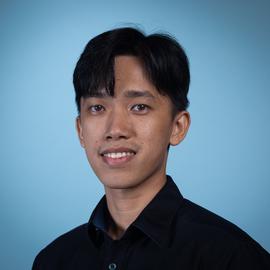

Duc Nguyen
Associate Professor of Mathematics
Duc Nguyen develops mathematical and AI frameworks for molecular bioscience, drug discovery, and scientific computing. His group blends differential geometry, graph theory, and machine learning to build high-fidelity models for biomolecular systems, with notable wins in the D3R Grand Challenges and collaborations with Pfizer and Bristol Myers Squibb. Supported by multiple NSF awards, he has advised students and postdocs across theory and applications of AI-driven drug design.